Outdoor artificial plants fail for one of three reasons: the base material wasn't UV-stabilized, the pigment was painted on instead of built into the fiber, or the wrong product was chosen for the local climate, whether that's intense UV, high humidity, or freeze-thaw. Pick a UV-stabilized PU or treated silk with pigment-infused fibers, match it to your climate, and most 'weatherproof' failures simply don't happen. The hard part for a procurement manager or hotel facilities director is that almost every supplier claims their product is 'weatherproof,' and almost none of them give you numbers to check that claim against.
Key takeaways
Outdoor-rated doesn't mean indestructible. It means the material has been engineered to resist specific degradation mechanisms for a defined period, and that period has limits you should know before you sign a purchase order. Too many buyers hear 'weatherproof' on a product page and assume it means forever. It doesn't.
There are three forces working against any artificial plant left outside: UV radiation, heat-driven hydrolysis, and humidity. UVA light in the 315–400 nm range attacks the C-H bonds in polyester, PU, and latex, which is the mechanical cause of yellowing you see in cheap outdoor stems. Separately, temperatures above 60°C accelerate hydrolysis of silk or PU polymer, causing thermal degradation and color shift, which matters if your storefront sits somewhere that hits that kind of surface heat in direct sun during summer.
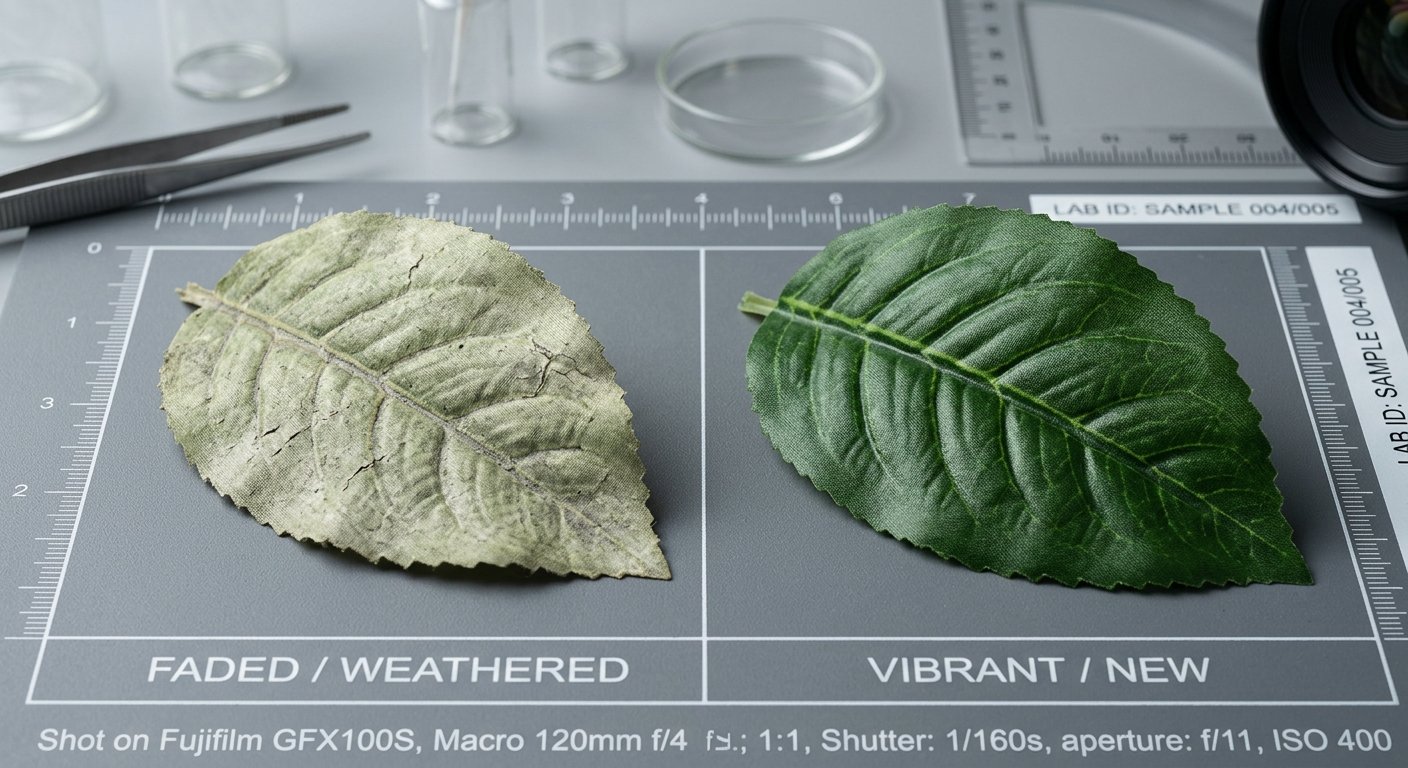
Untreated PU shows noticeable yellowing within 8–14 months in direct sun outdoors. UV-stabilized PU, by contrast, can last 2–4 years outdoors before fade becomes visible, and adding a clear topcoat with HALS additives can push that to 5+ years. In practical terms, that gap means the difference between budgeting for a full stock replacement every year and budgeting for one every few years.
For a hobbyist buying one planter, a bad SKU is an annoyance. For a buyer sourcing for 40 hotel properties or 500 storefront locations, one wrong material choice multiplied across every site is a real financial liability, not a cosmetic one.
Yellowing isn't one problem, it's three separate problems wearing the same symptom. Artificial flowers turn yellow primarily due to UV radiation breaking down polymer chains, oxidation of dyes and binders, and buildup of airborne pollutants like nicotine, kitchen grease, and dust. Each mechanism needs a different fix, and a supplier who only talks about 'UV protection' is only solving one-third of the problem.
If pigment sits as a surface coating, UV and oxidation attack it directly, and the color lifts or dulls quickly. Pigment infused into the fiber itself is protected by the bulk of the material around it, so it degrades more slowly and more evenly. This is also why cheaper dyes on artificial greenery fade to a dull yellow-green within 12-18 months under direct sun exposure: the color was never built to survive exposure in the first place.
Reputable suppliers test materials using standards like ASTM G154, which simulates UV exposure in controlled lab hours. In these tests, standard polyester silk shows a measurable color shift (Delta E 3) after roughly 300 hours of UV exposure, which is equivalent to about 4 months of indirect sun through glass. That's a useful benchmark: if a supplier can't tell you how many hours their material survived before hitting a Delta E of 3, they probably haven't tested it. UV-stabilized PU with HALS additives can extend resistance to 1,800+ hours before showing the same measurable shift, roughly six times longer. Ask for the number, not the adjective.
Material choice is the single biggest lever a buyer has over long-term outdoor performance, more than color, more than brand, more than price per stem. Standard silk is the lowest cost option but also the fastest to visibly fade outdoors, so it's best reserved for covered patios or display areas that don't take direct sun. Untreated PU is flexible and realistic to the touch, but without stabilizers it degrades fast once it's outside, showing yellowing within 8–14 months in direct sun as noted above.
UV-stabilized PU with HALS additives is the real workhorse for sustained outdoor exposure, holding up 2–4 years before visible fade, longer with a topcoat. Real Touch PU, the technology that coats artificial petals in a thin layer of polyurethane sometimes blended with latex to replicate the feel of a living flower, is rated for an indoor lifespan of 5–8 years with no visible degradation and under 5% color shift even at year 7. That's an outstanding indoor number, but it's an indoor number. Outdoor installations need the UV-stabilized variant plus a protective topcoat, not the standard indoor formulation, if you want anything close to that lifespan outside.
Temperature range matters just as much as UV exposure. Real Touch PU petals are rated stable from -20°C to +60°C, which covers most climates buyers source for, from desert storefronts to winter freeze-thaw cycles. Expect to pay for that performance: Real Touch PU costs roughly 2–2.5x what silk does per stem, reflecting the added material and processing involved, while standard silk remains the fastest material to fade once it's exposed to direct outdoor sun.
For a deeper look at the petal construction itself, see Real Touch Technology Explained.
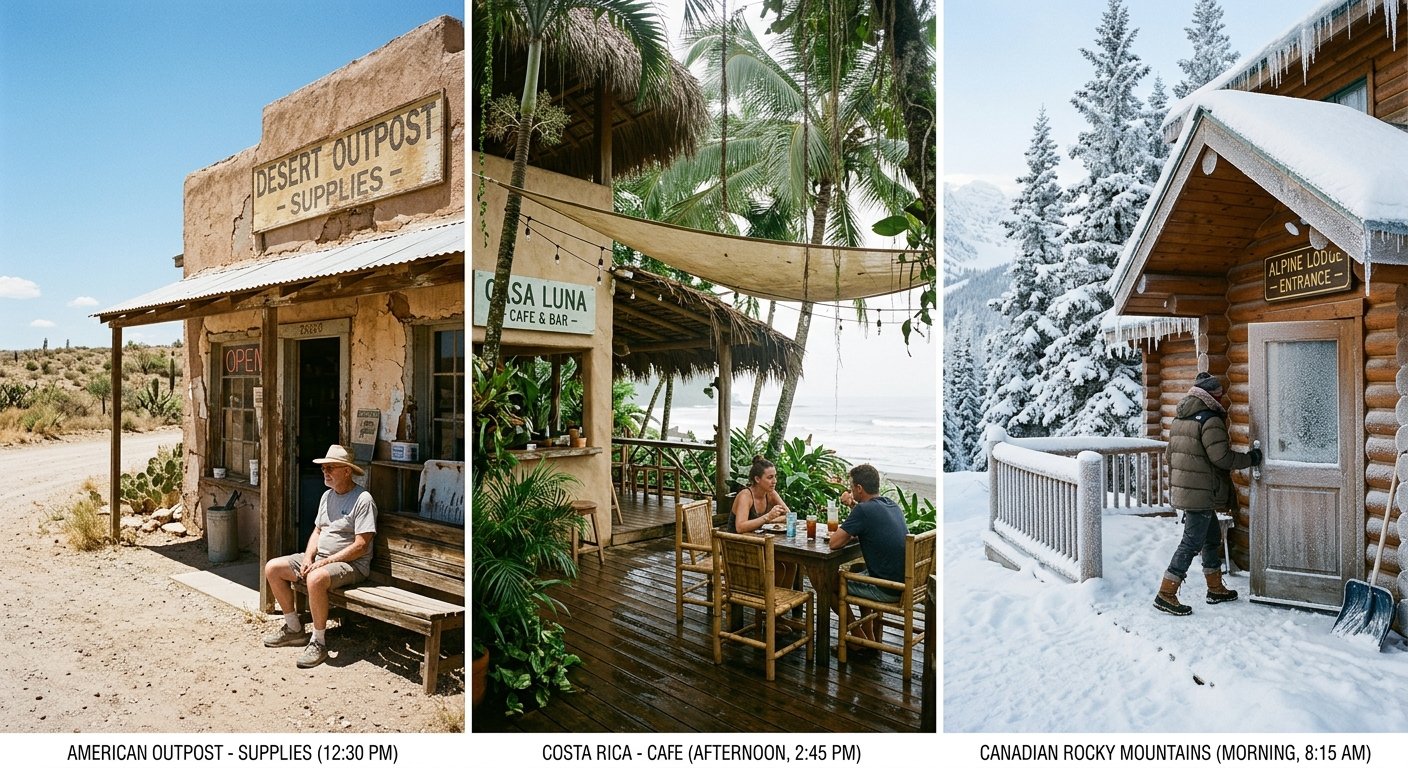
No single SKU performs the same way in Phoenix, Miami, and Chicago, and treating outdoor artificial plants as a one-size-fits-all product line is where multi-region buyers get burned.
Material choice solves half the problem. Installation solves the other half, and this is where a lot of otherwise good product gets ruined fast.
Big-box and lifestyle retail sites work fine for a single planter at a single location. They don't work for a buyer trying to match color, material, and fade performance across hundreds of units, because catalog retailers aren't set up to guarantee consistency at that scale, and they rarely disclose the material science behind their 'weatherproof' label.
A factory-direct supplier is a different proposition. When evaluating one, ask directly about MOQ flexibility, OEM customization for branding, and color-match tolerance in writing, not just verbally. artificialflowerplant offers flexible MOQ options adjusted based on product type, materials, and customer needs, along with OEM and ODM manufacturing services covering custom product development, color and material customization, and private label or brand packaging. That matters if you're trying to roll out a consistent look across multiple storefronts without reinventing the spec every time.
Sampling before a full commitment is non-negotiable, especially when entering a new climate zone or launching a storefront rollout. A good factory will turn around a full assembly sample in 7–10 days, which is fast enough to test fit and finish before locking in a bulk order. With 15 years of experience in artificial plants and more than 5,000 varieties of flowers, plants, and trees across silk, latex, PU, and blended fabrics, including Real Touch coating technology for a lifelike feel, plus support for adjustable flower head diameter and stem length, a factory-direct partner can match product specs to your specific climate and branding needs rather than forcing a generic catalog item to fit. See the full product range or review outdoor plant selection guidance for more detail on specific varieties.
Vague specs produce vague results. A purchase order that just says 'UV resistant outdoor artificial plants' gives a supplier room to interpret that however they like. Here's what to specify instead.
For the full breakdown of PO language for bulk orders, see how to specify private-label artificial flower bouquets and bulk artificial flower packaging guidance.
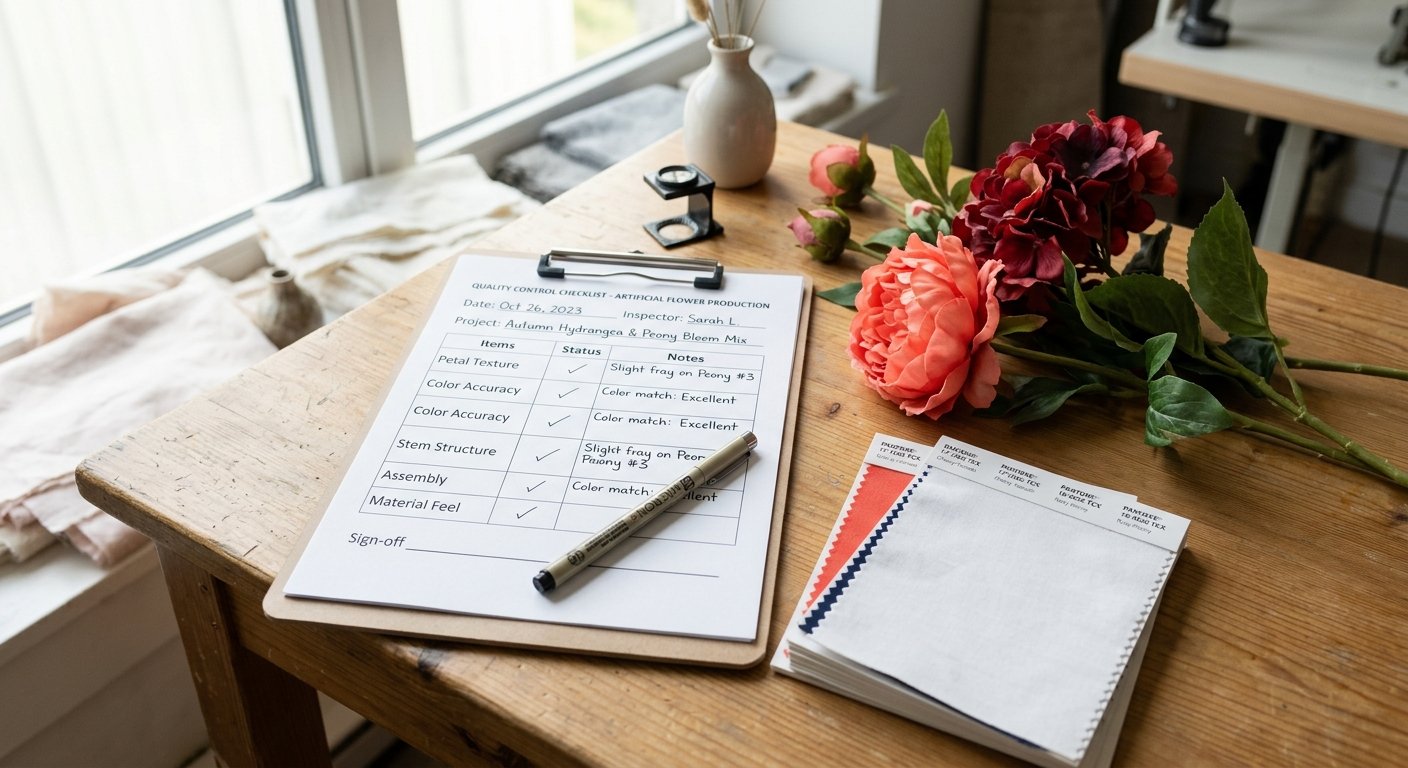
Pick the material based on your climate and exposure, not the price per stem. A storefront in Phoenix and a lobby planter under a covered walkway in Seattle have no business running the same SKU, and the fade timelines above show exactly why. 'Weatherproof' without written fade data and color-match tolerances behind it is just marketing copy, so push for the specifics before you sign.
If you're planning a multi-location rollout or testing a new climate zone, request samples and talk through OEM and MOQ terms with a factory-direct supplier before placing the full order. A test run on one or two sites, checked against the fade and color criteria above, tells you more about long-term performance than any spec sheet can.
Yes, but only if the material is engineered for it. UV-stabilized PU or treated silk with pigment-infused fibers can hold up for years outdoors, while untreated materials yellow within 8–14 months in direct sun. Match the material to your climate rather than assuming any 'outdoor' label guarantees long-term performance.
Use a planter with drainage to avoid standing water that breeds mold around the stem base, anchor tall arrangements with a weighted base against wind, and rotate displays periodically since south- and west-facing exposure fades material faster than shaded positions.
For single purchases, retail and lifestyle sites work fine. For bulk or multi-location projects, a factory-direct supplier offering OEM customization, flexible MOQ, and documented fade-resistance data gives far more consistency and accountability than a catalog retailer can.
Look for a manufacturer that offers sampling before bulk commitment, written color-match tolerances, and material options suited to your climate. A supplier with in-house production and OEM/ODM services can match product specs to your branding and regional exposure needs.
 Tips
 Tips
 Tips
 Tips
 Tips
 Tips