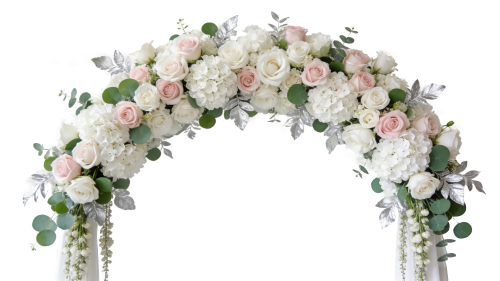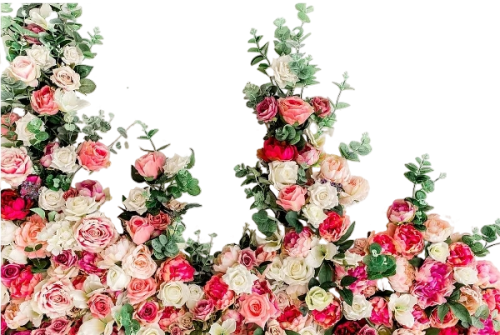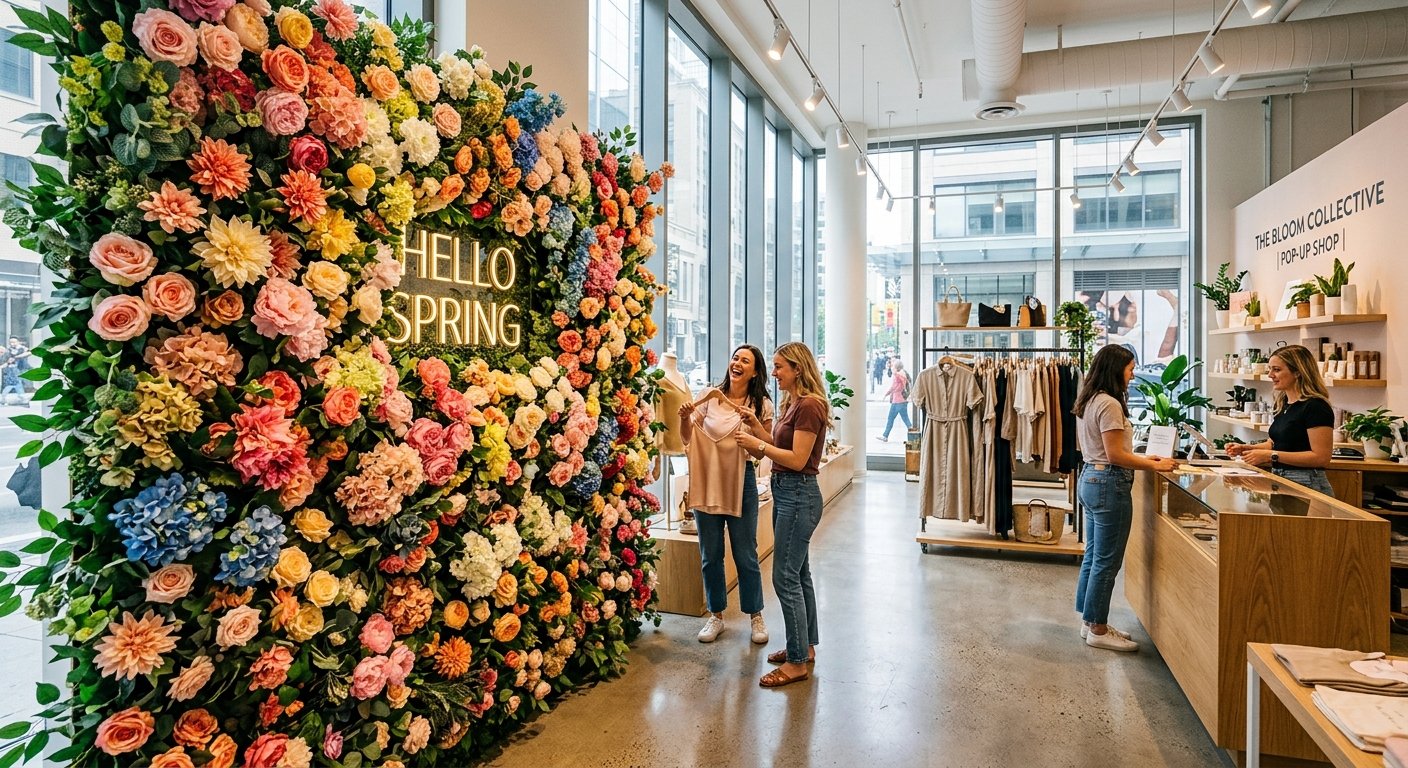
An artificial flower wall built for retail pop-ups needs three things real flowers and cheap printed backdrops can't offer: a material that survives repeated setup, teardown, and shipping between locations without fading or crushing; a panel system that installs in under an hour with no wall damage; and enough customization to carry brand colors and logos consistently across every site in a rollout. For brands running more than one pop-up, sourcing factory-direct also solves the batch-consistency and lead-time problems that off-the-shelf backdrop retailers can't.
Key takeaways
Fresh flowers start dying the moment they're cut. For a pop-up running three weeks, or a touring activation hitting five cities, that's a dealbreaker, not a minor inconvenience. Printed backdrops solve the wilting problem but create a new one: they're flat. Under retail lighting, a printed floral graphic reads as exactly what it is, a photo of flowers, and it shows up flat and lifeless in the Instagram shots your activation is designed to generate.
Artificial flower walls solve both problems at once. No wilting, no watering, and enough dimensional depth to catch light and shadow the way real petals do. The bigger shift, though, is cost math. A fresh floral install is a one-time expense tied to a single event. An artificial wall gets packed up, shipped to the next location, and reused for the next campaign. That changes the calculation from per-event spend to a reusable asset across a whole rollout calendar.
That reusability is exactly where most buying guides stop. What actually determines whether a wall survives that reuse, rather than looking tired by stop number three, comes down to material choice, panel engineering, and who you're sourcing from. That's what the rest of this guide covers.
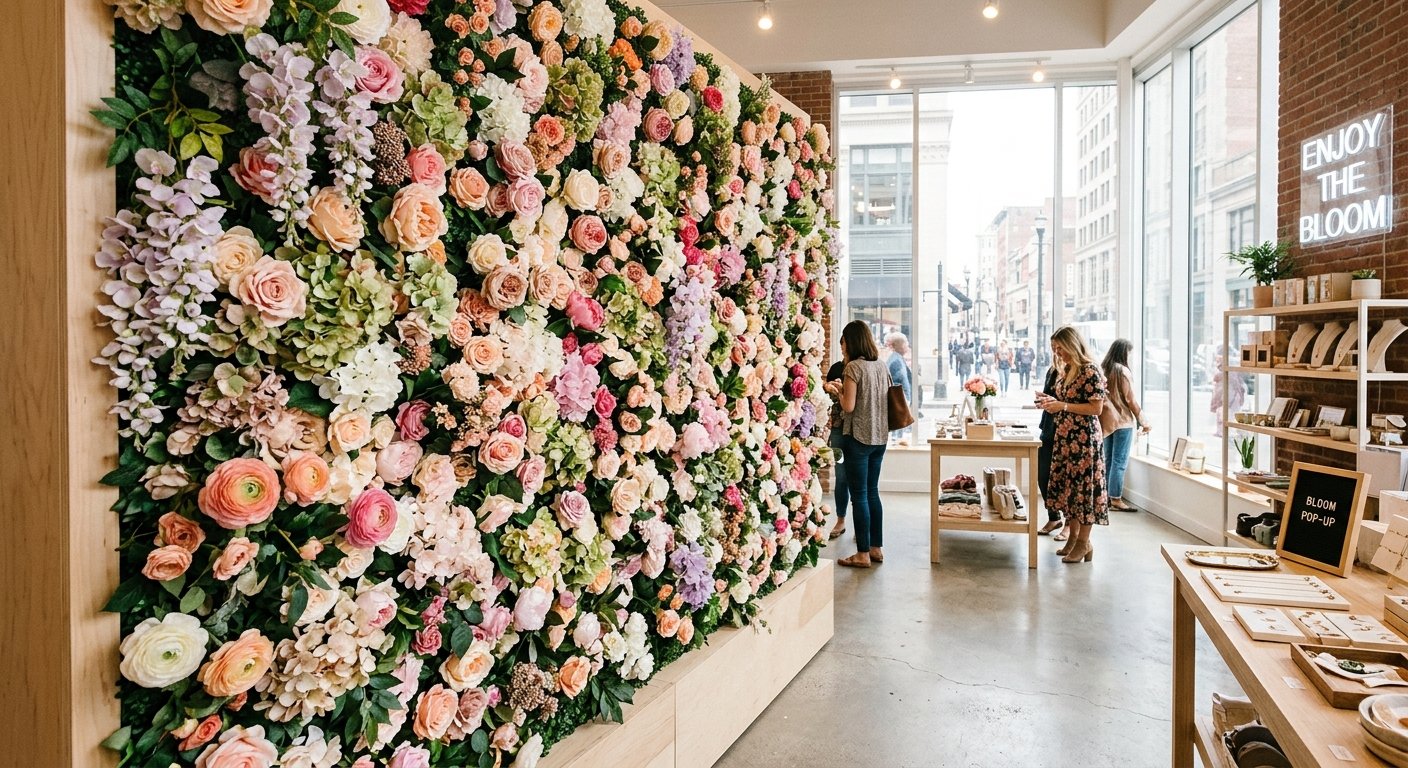
For a deeper breakdown of layout options and sizing logic, see this trade-ready guide to artificial plant wall ideas for businesses.
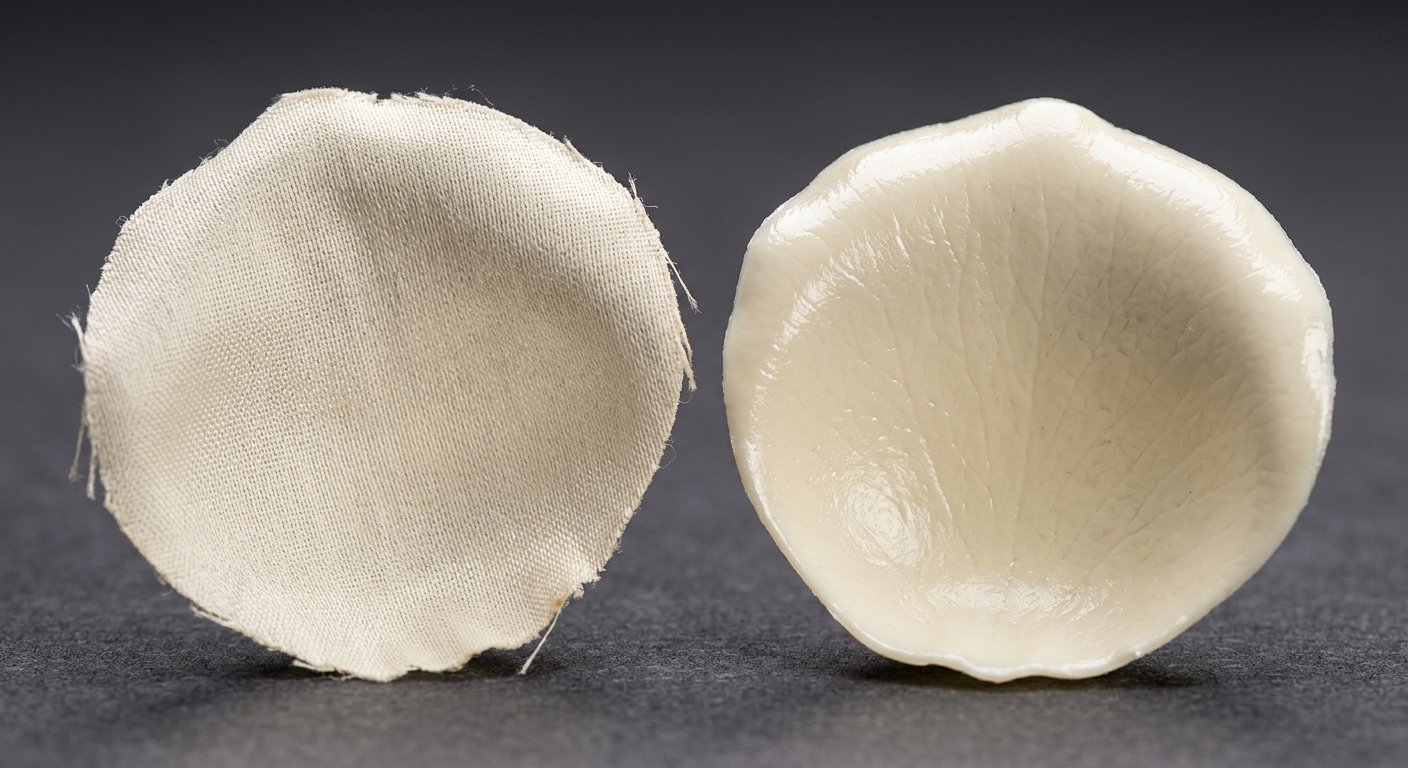
Silk is the cheaper option, and for a short single-location activation, that's often the right call. Silk per-stem costs in bulk can run 30-50% lower than PU equivalents. But silk fades. Near a south-facing window or a sun-drenched storefront, expect noticeable fading within 12-18 months without UV-treated coatings. A storefront display sitting behind glass all day gets that same intensity of light exposure, which is exactly the scenario that shortens silk's usable life.
PU and Real Touch petals cost more, running 20-40% higher for standard PU and 2-2.5x for Real Touch, but they resist crushing and keep their shape under the kind of repeated guest contact a photo-wall location takes daily. Real Touch petals use a PU coating 0.3-0.8mm thick with a Shore A hardness of 15-30, a range that sits closer to a soft rubber than a rigid plastic, which is what lets the petal flex under pressure rather than crack or hold a crease.
Real Touch petals have a surface energy of roughly 30 dyne/cm, which helps them resist dust and grime buildup. That's a real factor for a wall that gets packed into a crate, shipped, unpacked, and reinstalled at the next venue, over and over.
In accelerated UV testing, standard polyester silk shows a visible color shift after about 300 hours of exposure. UV-stabilized PU with HALS additives holds up past 1,800 hours. For a storefront window getting daylight all day, that gap is the difference between a wall that looks fresh for one campaign and one that holds its color across a full season. Untreated PU outdoors yellows within 8-14 months in direct sun; a UV-stabilized version with a HALS topcoat can push that past 5 years. For more on what fade-proof actually means in practice, see this breakdown of UV-resistant artificial plants, and for a side-by-side material comparison, read Silk vs. PU vs. Latex: Which Artificial Flower Material Is Right for Your Product Line.
A retailer running pop-ups in five cities needs the panel color and flower mix to match exactly from location to location, not just 'close enough.' A customer walking into your Chicago pop-up and your Austin pop-up should see the same wall. Off-the-shelf backdrop retailers sell fixed catalog designs. You pick from what they've already made. There's no mechanism to match your brand palette precisely, because they're not formulating the colors, they're reselling someone else's stock.
A factory-direct supplier works differently. Color can be matched through custom formulation against your brand guidelines rather than chosen from a limited set of preset options. OEM/ODM customization covers color, panel size, flower mix, and even private-label packaging, so every location in a rollout receives an identical kit, down to the box it arrives in.
With up to 30+ color options available for customization, matching a specific brand palette gets a lot more precise than picking the closest match from a standard catalog. And with 5,000+ varieties of flowers and plants to choose from, brands can build a specific aesthetic instead of being locked into generic rose-and-hydrangea combinations that every competitor's pop-up also uses. See the custom options available for how far this customization extends.
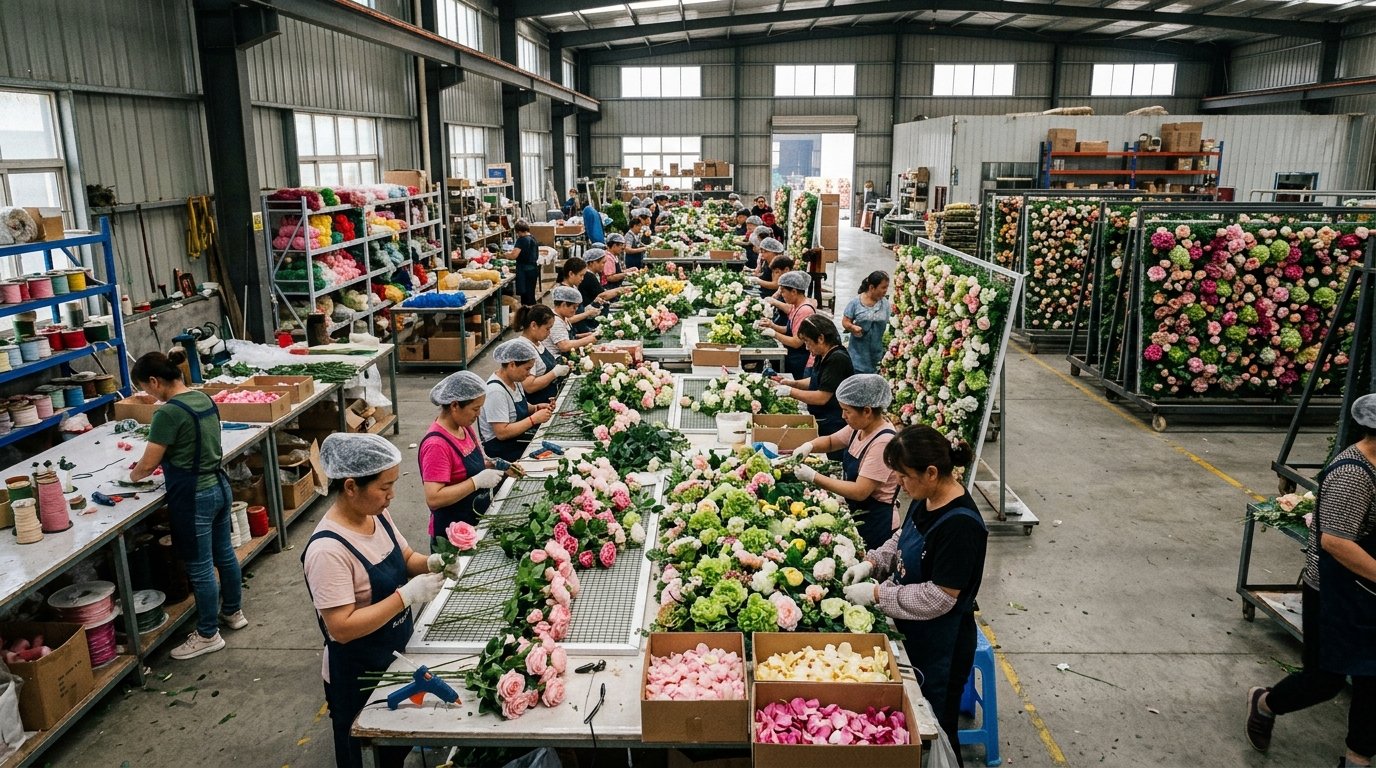
A single-store hire company can supply one wall for one event. A multi-location rollout needs something different: a supplier that can produce consistent quantities on a repeatable schedule, month after month, as new locations open.
Flexible MOQ and fast sampling cycles matter most during the approval stage of a seasonal campaign, when marketing needs to sign off on a design quickly before full production starts. Waiting weeks for a sample when your launch date is fixed isn't a workable position.
Monthly production capacity of 300,000+ units gives a rollout across a dozen locations the headroom it needs to ship on the same timeline, rather than being staggered one batch at a time. That kind of volume matters once you're ordering for multiple storefronts at once instead of a single installation.
Specifying exact stem count, color ratio, and panel density at the order stage, rather than approximating, pays off later. One hotel chain ordering lobby arrangements across 40 properties specified stem count per SKU down to the filler ratio, which let them reorder matching replacement bouquets two years later with no visible difference. The same discipline applies to a retail rollout that needs matching walls for next season's campaign. For more on specifying orders this precisely, see How to Specify Private-Label Artificial Flower Bouquets.
If yellowing in storage is already a concern from past orders, this guide on why artificial flowers turn yellow covers the causes and prevention in more depth.
Hire companies are fast and convenient for a single local event. They're not built to scale to multi-market rollouts, and they can't offer custom branding because they don't control the manufacturing. Backdrop resellers have the opposite problem: they sell fixed catalog designs with no influence over material sourcing or batch color consistency. Order the same design twice and you might get two slightly different shades.
A factory-direct supplier changes the equation. In-house production paired with a global alliance of 150+ factories means capacity can flex for large or multi-region orders. That matters when you're ordering for ten locations at once, not just one.
Fifteen years of manufacturing experience and supply to over 50 countries signal the kind of operational maturity a multi-site retail rollout actually needs from a supplier, not just a nice-looking sample, but the ability to repeat that quality at scale, on schedule, across borders. If you're still weighing suppliers, How to Choose the Best Wholesale Artificial Flowers Supplier covers the broader vetting criteria.
Start by matching material to the wall's location and handling level. Silk works fine for a short single-site run, but anything touring multiple cities or facing heavy photo traffic needs PU or Real Touch to hold its shape and color. Lock brand color and design early if the wall needs to replicate identically across several sites; color formulation and sign-off take time, and rushing it leads to mismatched walls down the line.
Confirm MOQ, lead time, and sampling cycle against your rollout calendar before committing to a final design. And if walls will travel between regions or sit in storage between seasonal campaigns, factor in packaging and export requirements from the start rather than as an afterthought.
artificialflowerplant's in-house production and OEM/ODM capabilities, covering color, sizing, packaging, and branding, support retail brands planning multi-location pop-up or activation rollouts. Get in touch to talk through material options, MOQ, and timelines for your next rollout.
Indoors, Real Touch PU petals can hold their appearance for 5-8 years with minimal color shift. Silk holds up indoors for 3-5 years before noticeable fading, less if the wall sits near direct sunlight or storefront windows. Material choice should match how many campaigns the wall needs to survive.
Yes. OEM/ODM customization covers color formulation, panel size, flower mix, and private-label packaging, so a wall can be built to match specific brand guidelines rather than chosen from a fixed catalog design. Up to 30+ color options support precise palette matching.
Hire companies suit a single local event but don't scale to multi-location rollouts or offer branding customization. Factory-direct sourcing provides consistent batch quality, bulk MOQ flexibility, export packaging, and OEM customization that hire companies and resellers, who don't control manufacturing, simply can't offer.
 Tips
 Tips
 Tips
 Tips
 Tips
 Tips