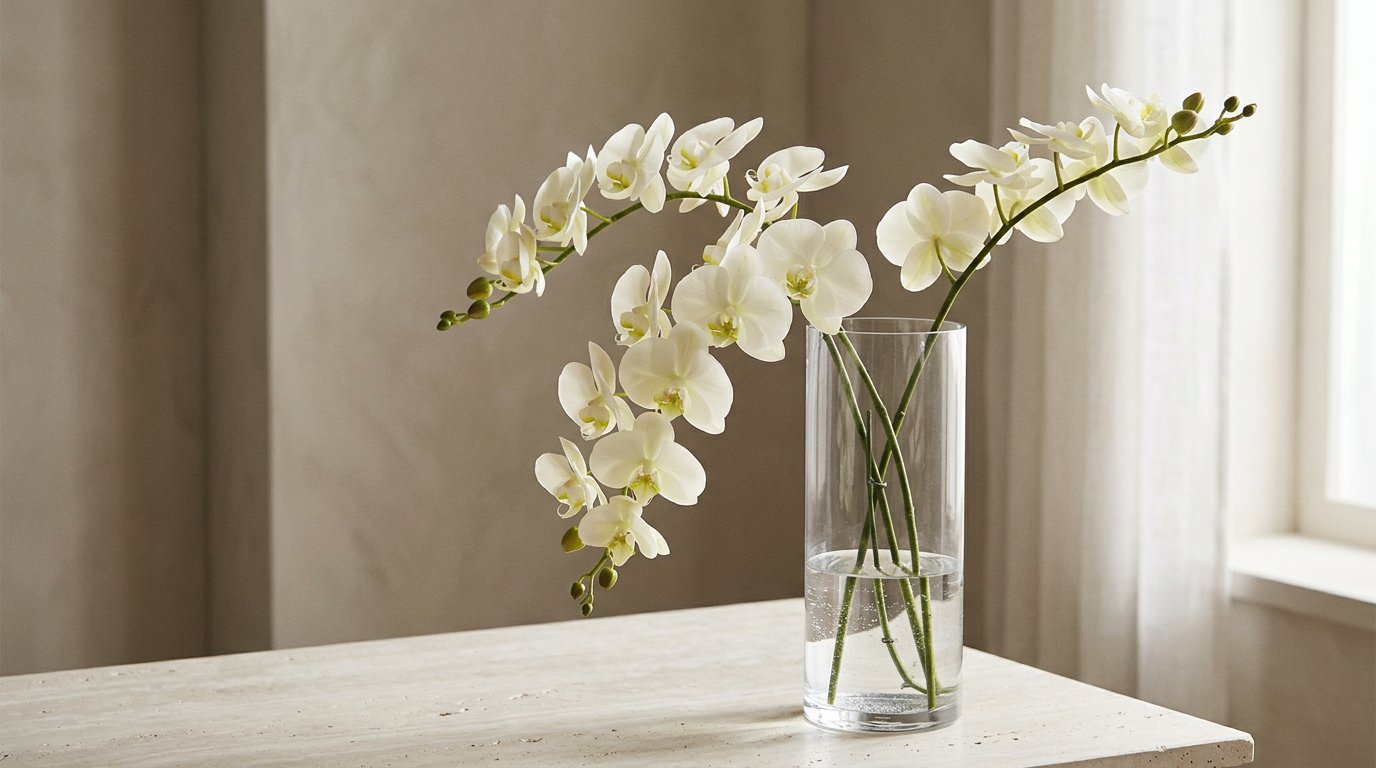
An artificial orchid stem is decided by four numbers, not by a photo: bloom count per stem, overall length and how much of it disappears inside the vase, stem diameter with its wire configuration, and bud count. Get those four right and match the material grade to the light the stem will live in, and the arrangement looks correct on day one and still matches when you reorder two years later. Everything else on the listing is decoration. What follows is how to read a stem like a component, calculate vase fill instead of guessing it, and write the whole thing down on a purchase order.
Key takeaways
A product photo shows a stem in the best light a photographer could find. It tells you nothing about what lands in the carton. Buyers who compare on price alone end up with arrangements that look thin in a wide vessel or top-heavy above a narrow neck, and they discover it after the container has cleared customs. So demand five fields before you look at cost.
This sets visual mass. The same stem reads sparse in a wide-mouthed floor vase and generous in a narrow bud vase, which means count and vessel have to be chosen together, never separately. A buyer who shortlists a stem first and picks the vase later will always end up ordering twice.
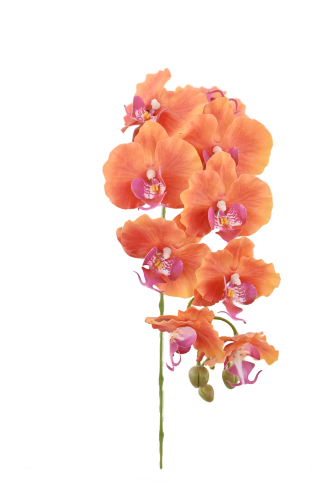
A real orchid spike opens from the base upward, so two to four tight buds at the tip with open blooms below is the arrangement that ages convincingly in the eye. A spike of uniform open blooms reads as manufactured, no matter how good the petals are.
Diameter relative to bloom size predicts droop. A large cast bloom on a thin stem needs a reinforced or double wire to hold an arch above the vase neck. Ask which wire configuration the SKU uses, not whether it is wired. Wired is the minimum; the question is how much.
Cutting a wired stem shortens the stiffened section and removes the base that grips the vase. Decide the finished height before anyone picks up cutters, and order length to suit that decision.
Both belong on the spec. Orchid stems sold without leaves, or with leaves pinched on at the wrong height, are the most common reason a good bloom still looks wrong in the arrangement.
If a supplier cannot send a per-SKU sheet listing bloom count, bud count, total length, stem diameter, wire type and leaf count, that silence is itself the answer about how the product was specified.
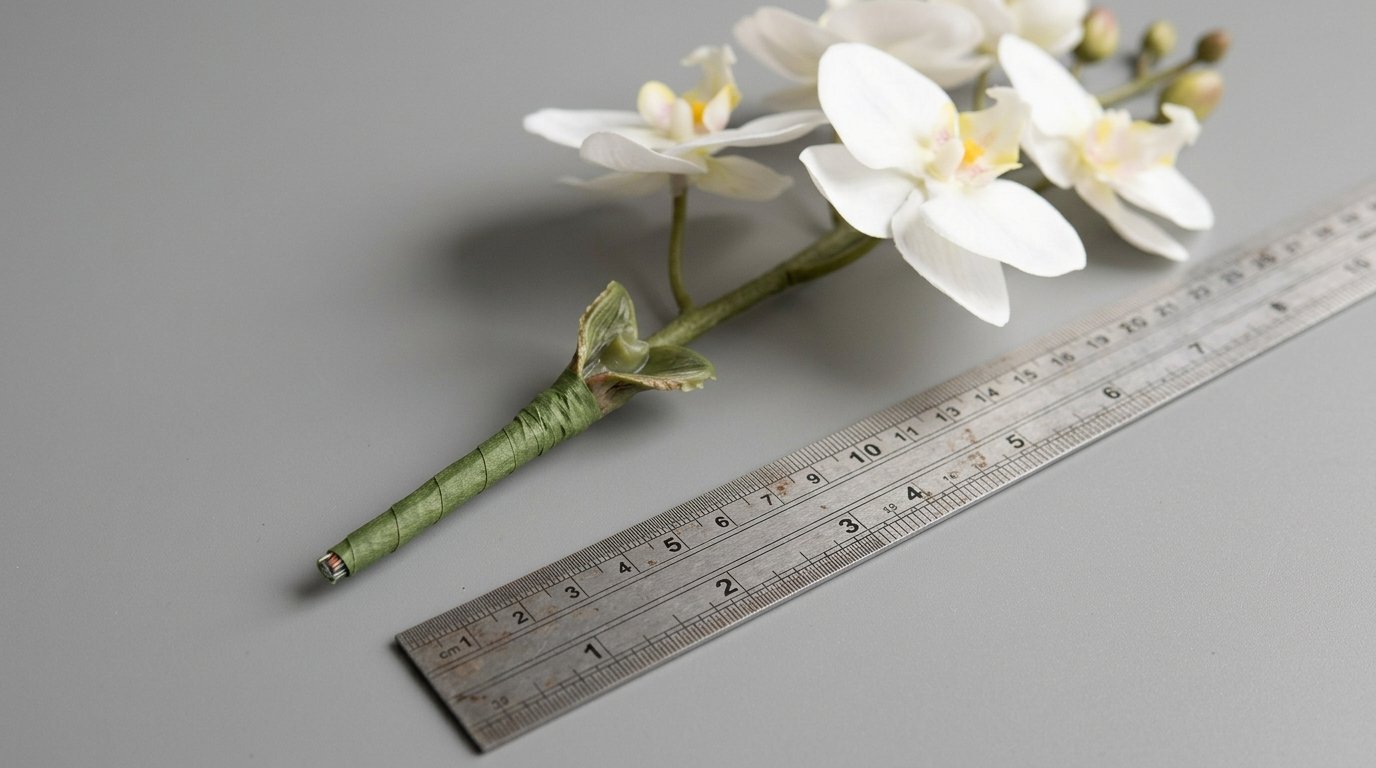
A real orchid bloom is three sepals plus three petals, one of which is the modified labellum, arranged around a central column. Every bloom on the spike follows that plan. A listing advertising three-petal blooms is describing a silhouette, not a flower, and the shortcut usually reveals itself as a flat, undifferentiated lip.
So look for the lip first. If it has lobes, a slight recurve and some thickness in the hand, the replica was built from a real reference. If it is a flat stamped shape glued to the face, the bloom will read wrong at conversational distance even when the color is perfect. Cast petals carry vein relief and edge curl; stamped petals are smooth and uniformly thick.
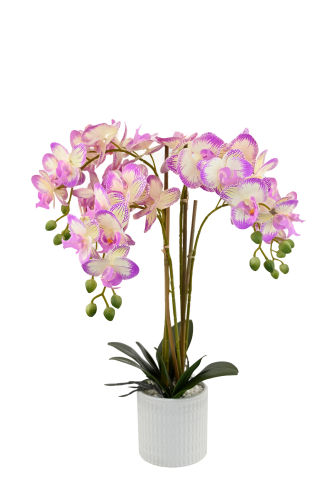
Species decides bloom count, stem habit and what large even means. Moth orchid (Phalaenopsis) means fewer, larger, wide-faced blooms on an arching spike. Cymbidium means a heavier spike of many blooms. Oncidium means a branching spray of small blooms. Dendrobium means blooms distributed along a segmented, cane-like stem. Pick the species first, then argue about counts, colors and price. If you are still weighing how species and construction change what a display reads like at arm's length, this comparison of types of artificial flowers and how to choose them for professional displays is worth ten minutes before you shortlist.
Bloom counts vary by species and cultivar, so never accept a generic figure. Count open blooms and buds on the approved sample, write both numbers on the purchase order, and keep that sample on file as the reorder reference.
As a gauge of how much hand work cast construction implies, a Real Touch rose head typically carries 18 to 40 individually cast petals depending on variety. If an orchid listing quotes a suspiciously low part count for a large bloom, ask how the lip and column were built. Real Touch does not guess at this scale either: botanical scanning captures vein structure at roughly 50 micron resolution, cast film runs 0.3 to 0.8 mm thick, hardness sits at Shore A 15 to 30, and translucent base resin lets 15 to 25 percent of incoming light pass through before reflecting back. Depth comes from that film and translucency, not from an airbrush.
Length is quoted base to tip. Visible height is total length minus whatever sits inside the vessel, and visible height is the only figure the client or the camera ever sees. A 35 inch stem dropped to the bottom of an 8 inch vase shows roughly 27 inches. The same stem held at the neck shows nearly all of it. One SKU, two completely different arrangements.
Seat the stem on the bottom and you gain stability plus a shorter silhouette. Grip it at the neck and you gain height but risk the whole bundle tipping. Tall floor vases with a narrow neck solve this without a decision, because the neck does the gripping and length is nearly all visible.
35 inch is the common retail reference length in the US market, which is why a shelf of American listings, Nearlynatural and Petals among them, sit exactly there. Wholesale and installation work usually needs a spread of lengths instead, so a group of stems finishes at different heights rather than on one flat line. Ordering a single length for a 40-vase rollout is how a lobby ends up looking like a fence.
Wired stems shape by hand and hold, which is why cutting should be the last resort rather than the first move. Cut only at the base, and only when the finished height genuinely demands it. Anything taken off the base is length you cannot put back, so shape the arch first, stand it in the vessel, and only then reach for the snips.
Thin stems in a wide mouth splay outward and the arrangement collapses into a fan. That is a diameter problem, not a design problem, and no amount of rearranging fixes it. For a fixed installation, measure the finished sightline first, meaning table height, seated eye level and ceiling clearance, then work backwards to the length you order. The same dimensional discipline applies to artificial potted plant sizing for commercial interiors, where canopy width and viewing distance drive the number instead of stem length.
Most guidance on this stops at use one to three stems, which tells you nothing about your own vessel. The number you need comes from two measurements: the neck opening and the stem diameter, plus the depth of the vessel.
How many stems of a given diameter can actually pass through that opening? That number, not taste, is the ceiling on any arrangement. A bundle pushed to the ceiling crushes its own stems, hides the blooms against each other and splays at the mouth. Work below it, at roughly two-thirds of the geometric limit, so stems can splay and cross. Crossing is what makes a bundle look arranged rather than inserted.
For orchid work the orchid carries the eye and the filler greens mask the mechanics below the neck, so the ratio is fixed by function. Decide it once and write it into the repeat order so year two matches year one. A hotel chain ordering lobby arrangements across 40 properties did exactly that, specifying stem count per SKU down to the filler ratio, and reordered matching replacement bouquets two years later.
Finally, prototype in the actual vessel. Neck diameter and interior depth are the two figures that change the answer, and both are routinely misjudged from a photo, so a mock-up in the real vase costs far less than a bulk run built to the wrong dimensions.

In the trade, silk flower is a category label, not a material. It covers polyester, nylon, PVC, latex and rubber. Ask which one you are being quoted, because the word on its own tells you nothing about how the stem will age. A supplier who cannot answer that question has not spec'd the product either.
Stamped or printed fabric over a wire. Bright, light, cheap per stem, and it shows a sheen when light rakes across the face. For large event work seen from a few metres it is the efficient choice, and buying it is not a compromise so much as a correct read of the viewing distance.
Soft, springy hand feel with good shape recovery, which suits petals that get handled on a display table or pressed into a sample book a hundred times a month.
A thin cast film, often over a fabric backing, so the petal has real edge thickness, vein relief and slight translucency. It is the only grade that survives a customer picking it up, and the mechanism behind that is covered in this explainer on Real Touch technology explained.
Test at arm's length rather than in a photo. Squeeze a petal and release: it should recover, not crease. Look at the edge thickness. Hold it up to a light source and check whether some light passes through.
PU runs roughly 2 to 2.5 times silk per stem on comparable work, and silk in bulk can land 30 to 50 percent below the PU equivalent. That is a real gap, so spend it where hands and eyes get close: lobby arrangements, guest-facing tables, private-label retail SKUs. Use silk where distance does the work. If the stem will be touched or photographed close, buy PU. If it will be seen from three metres away for one season, buy polyester silk and put the savings into more coverage.
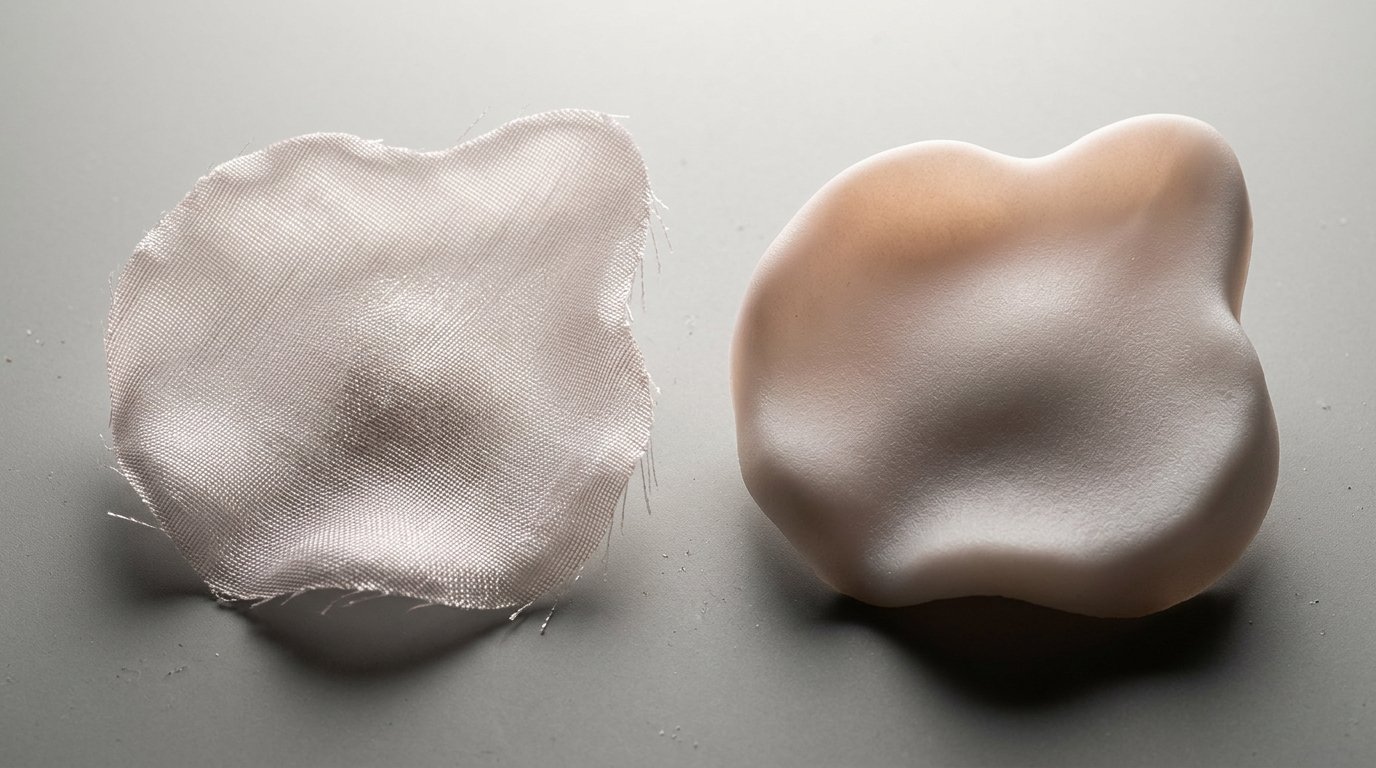
Placement is part of the specification, not an afterthought. Two identical stems in the same building can age five years apart depending on which side of the lobby they sit on.
PU Real Touch holds up for 5 to 8 years with no visible degradation, and color shift stays under 5 percent even at year seven under fluorescent or LED light. That is the baseline for hotel and office interiors. Polyester silk gives 3 to 5 solid years before noticeable fading, but position changes everything: near a south-facing window or in a sun-drenched lobby it degrades within 12 to 18 months without UV-treated coatings. Shade is a spec line.
Untreated PU yellows within 8 to 14 months in direct sun. UV-stabilized PU pushes visible fade out to 2 to 4 years, and a clear topcoat with HALS can extend that past 5. If the brief says patio, atrium or glass-roofed lobby, the treatment question comes before the color question. Accelerated weathering gives you a comparable number rather than a promise: under ASTM G154, standard polyester shows a measurable color shift of Delta E 3 after roughly 300 hours of UV exposure, while UV-stabilized PU with HALS additives reaches 1,800-plus hours. Ask for the test basis, not the marketing adjective.
PU petals stay stable across a wide band, from -20°C to +60°C, which matters for unheated venues and for containers sitting on a hot loading dock. Commercial cleaning is the other wear factor nobody budgets for. Thin cast films tolerate gentle dusting and a dry microfiber wipe; repeated harsh chemical wiping abrades the surface long before sunlight would, so it pays to know simple ways to clean artificial flowers and to write one method into the maintenance contract.
Flame retardancy for public spaces is a local requirement, not a product feature. Requirements differ by jurisdiction and occupancy type, so check the applicable code and ask for test documentation on the specific SKU rather than assuming any treatment is standard.
Incoming inspection is the only point where a problem is still cheap to fix, and a routine you can run in ten seconds per stem catches almost everything a photo hides.
White and pastel SKUs need acid-free tissue and BHT-free packing, because yellowing in transit is a packing problem before it is a chemistry problem. Then check the stack: delicate white florals should not be stacked more than four cartons high, and crushed top layers are a loading decision made at the warehouse rather than a manufacturing defect.
Sample the cartons rather than the box on top. Pull roughly one stem from several cartons across the consignment and count blooms against the approved sample, because the top box is always the one the factory wanted you to see.

Consistency is engineered through written specifications and retained samples. It is not a promise a supplier makes on a call, and it does not survive an email thread full of RGB values.
A European hotel supply distributor switched their entire orchid and rose line from silk to PU after guest feedback. The material upgrade cost roughly 25 percent more per arrangement, and the reorder rate from hotel clients jumped by over 40 percent in the following year. For color consistency at scale on large stem counts, the wedding planners playbook for sourcing 1,000+ stems applies the same logic to a different calendar.
Eleven lines turn everything above into something a factory can quote against and a warehouse can check against. Copy this list into your next RFQ.
Then ask for what you cannot verify from a web page. artificialflowerplant is the trading name of Xuzhou Blossom Sparkling Art&Crafts Co.,Ltd, based in China, with 15 years in artificial plants and more than 5,000 varieties including a Real Touch Moth Orchid line. Monthly capacity is 300,000+ units, custom color reaches up to 30+ options, and shipments have gone to over 50 countries. Send the vase dimensions and the finished sightline you need, and ask for a stem built to that specification rather than the closest thing on the shelf. Start with the contact page and ask for a per-SKU sheet plus a physical sample.
No. Most stems are built on a metal wire core wrapped in tape or coated fabric, and standing water corrodes the wire and softens the wrap. Use a dry liner, a sealed inner cup or decorative filler such as moss or gravel instead. A dry vase also removes the maintenance task entirely, which is usually the reason the stem was bought.
Spray usually describes a branching stem carrying several blooms along lateral branches, while stem refers to the single main axis you hold. Sellers use both words loosely, so ask for the bloom count either way. The count, the length and the wire configuration matter more than the label on the listing.
Not by default. Flame retardancy for public spaces is set by local code and by occupancy type, and it varies by jurisdiction, so confirm the requirement for your specific venue first. Then ask the supplier for test documentation covering the exact SKU and treatment you are ordering, rather than accepting a general statement about the product range.
 Knowledges
 Knowledges
 Knowledges
 Knowledges
 Knowledges
 Knowledges