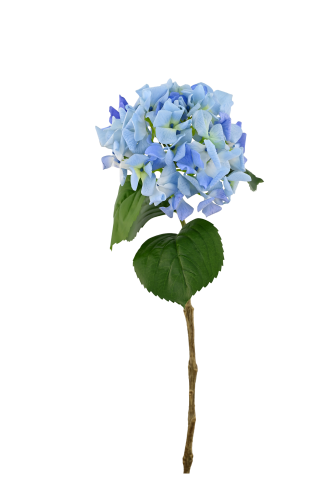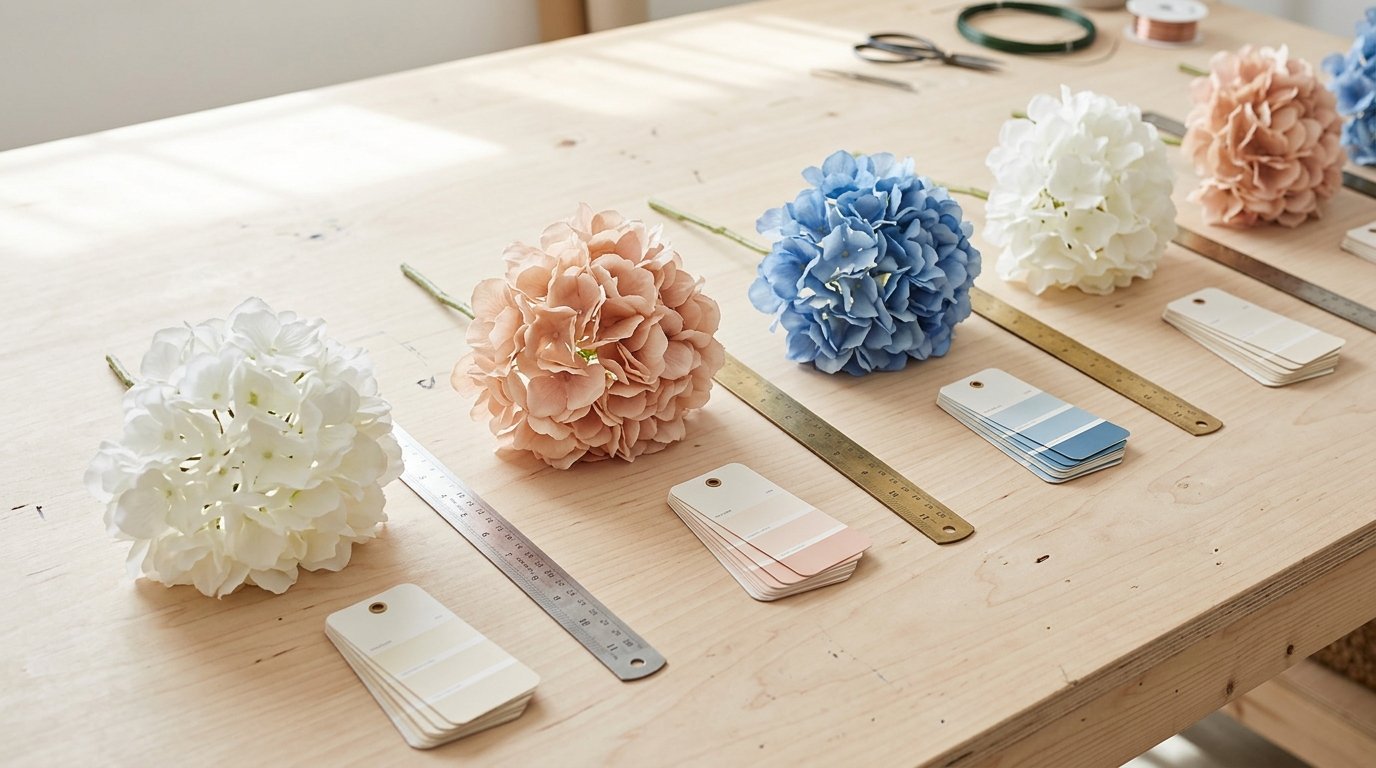
Pick artificial hydrangea heads by diameter and by count, not by stem. Match the head diameter to the container mouth and to the farthest viewing distance in the room, calculate how many heads the display needs, and buy that quantity at a stated diameter band and floret density so every arrangement in the run looks identical. Every decision after that, from cost per usable head to whether a lacecap can fill the wall a mophead filled last year, falls out of those four numbers.
Key takeaways
Ask three suppliers for a “large” artificial hydrangea head and you get three different flowers. The word describes nothing anyone can be held to. Force four numbers onto the quotation and the quotes become comparable in about ten minutes.
| Specification | How to state it | Why it changes the order |
|---|---|---|
| Head diameter | Across the widest floret spread on a relaxed, unstyled head, in centimetres, with a tolerance | A head measured straight out of a compressed carton reads smaller than the same head after steaming, so the measuring method matters as much as the figure |
| Floret count and floret size | Two separate numbers | Many small florets and fewer large florets can reach the same diameter while producing completely different visual density |
| Heads per stem | Single head or multi-head spray, stated per stem | Cost per usable head depends on this more than on head size |
| Mount | Fixed to the stem, or wired for repositioning | A wired head can be bent to face outward on a wall or arch; a fixed one cannot |
A 0.3 to 0.8 mm Real Touch petal film and vein structure scanned at roughly 50 micron resolution are what a buyer is paying for at close range, and neither shows up in a centimetre figure. Floret count carries the density. Petal construction carries the realism. Quote them separately or you will end up comparing a dense head against a hollow one at the same price.
Bands are not standardised across the trade. Across a catalogue of 5,000+ varieties of flowers, plants and trees, the same hydrangea head can appear in three grades, so name the grade and its centimetre range in writing.
Relaxed head diameter with tolerance, floret count band and floret size, heads per stem and mount type. A blank line on any of the three is information: it usually means the number moves between batches.

A display brief never arrives as a head count. It arrives as twenty rounds, a six-metre arch and a photo wall, and converting that into a purchase order is the buyer's job. Here is the order of operations.
Two contract details decide whether the plan survives contact with the calendar. Capacity first: a factory running 300,000+ units a month across a network of more than 150 allied factories can absorb a seasonal spike that a single-line trader cannot. Consistency second: a hotel chain ordering lobby arrangements across 40 properties specified stem count per SKU down to the filler ratio, and could still reorder matching replacement bouquets two years later. Neither of those is luck.

Shape decides whether the head count you just calculated is right. Two displays with identical head counts and identical spend can look full or half-finished purely because of the silhouette.
A dense dome of florets, and the default for even fill. The silhouette is already a solid mass, so it reads full from any angle and makes a coverage calculation behave predictably. If you want a wall to look finished on the first attempt, this is the shape that does it.
A flat ring of large sterile florets around a tiny fertile centre. It reads open and airy, which means it needs a higher head count per square metre to avoid looking sparse. A poor choice for a solid flower wall and a very good choice for a garden-style table runner, where the gaps are the point.
A tapering panicle that carries vertical height well, but it needs graduated head sizes along the stem or the taper looks stepped rather than natural. Stem architecture matters here too: a drooping panicle needs a stem that carries the head weight without a visible kink, and a kink is the fastest way to spot an under-specified wire.
Sold alongside hydrangeas but botanically a viburnum. Rounder and more uniform, which makes it useful for tight repeated pattern work where identical spheres help, and less useful where you want the irregular dome of a real mophead.
Switching shape means re-quoting the display, not swapping one product code. Moving from mophead to lacecap on the same wall changes the head count, and therefore the budget, even when the unit price stays flat.
The range at artificialflowerplant covers Real Touch hydrangea heads alongside silk hydrangeas, bouquets, wreaths and arch components, so a shape decision and a stem decision can be settled in one enquiry rather than three. If the shape vocabulary itself is new to you, the guide to artificial flower types for professional displays covers the rest of the family tree.
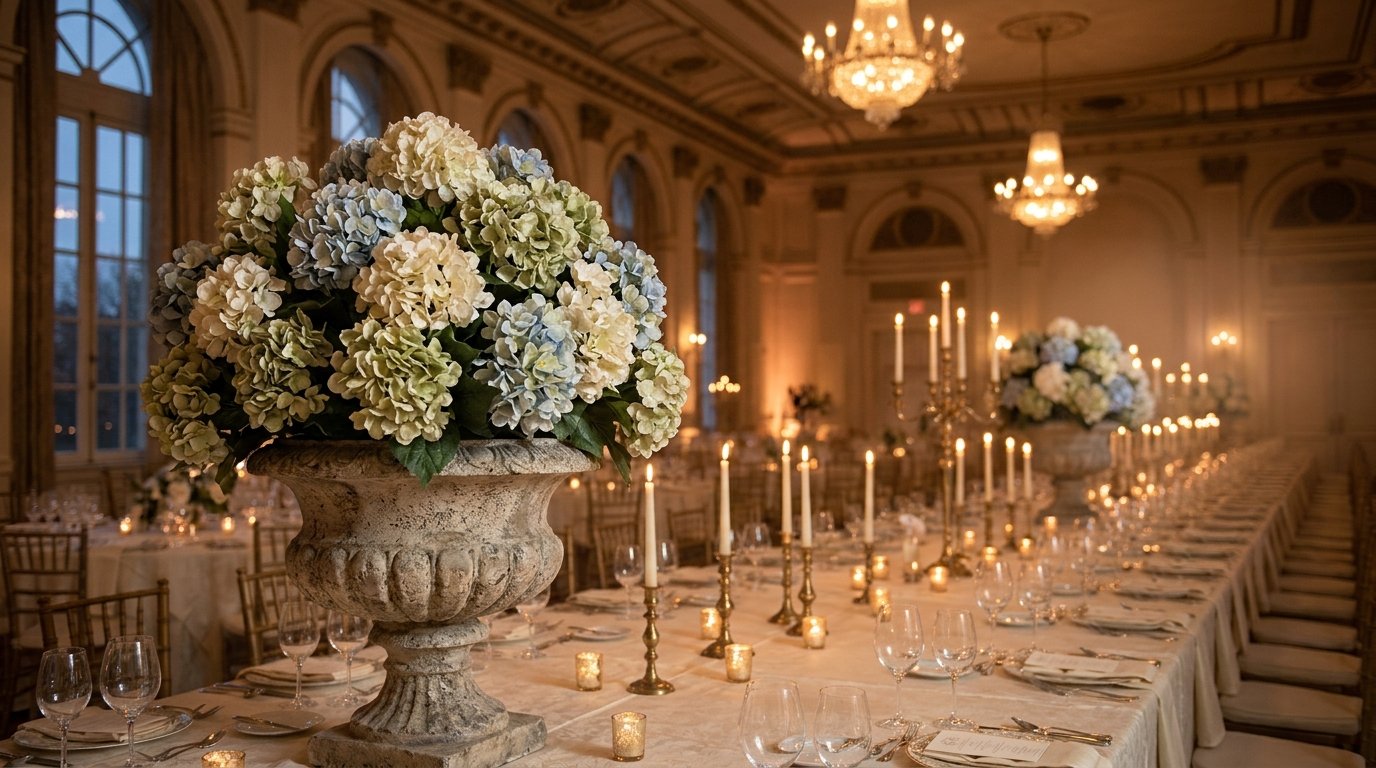
Size is a function of distance. The head that looks generous from the back of a ballroom can look oversized and coarse at the head table, and both judgements happen in the same room, in front of the same people.
At distance the eye judges silhouette, mass and colour, so a larger head carries the arrangement and a small one dissolves into the linen. Up close the eye judges floret edges, veining and finish, which is exactly where an oversized head with a coarse floret pattern starts to fail. Write the farthest viewing distance into the brief before you look at a catalogue.
The container mouth is the anchor. A head that is small against a wide urn reads as skimped, and a head that overhangs the rim heavily makes the arrangement look top-heavy and unstable, however good the head is on its own. Match diameter to rim, then check the result at the target distance.
Stem length plus head diameter gives the installed height. Specify both together, and state head weight when you want a heavier gauge stem or internal wire, because a supplier cannot gauge wire against a diameter nobody quoted.
Walls, arches and ceiling grids are viewed from below at an angle. Flatter faces win, and a domed mophead chosen for tabletop work shows its underside to every guest who looks up.
Close viewing rewards surface detail: a Shore A hardness of 15 to 30, vein structure scanned at roughly 50 micron resolution, and a translucent resin that lets 15 to 25% of incoming light pass through before reflecting it back. A workable grading rule is grade A for head-table and reception-desk distance, grade B for banquette seating and mid-room, and grade C for backdrops and ceiling work where nobody stands within touching distance.
Buying one grade for a whole event is usually a false economy. Split two grades across near and far placements and the budget goes where the inspection actually happens. The same logic drives plant sizing by canopy width and viewing distance, and it transfers to heads without modification.
Material decides how a head behaves after six hours in a carton and six months in a lobby. Not how premium it sounds on a product page. Here is what each construction actually predicts.
| Property | Silk | PU Real Touch | Latex and blends |
|---|---|---|---|
| Handling weight | Lightest per stem | Denser, weighted by the coating | Variable, usually springy rather than heavy |
| Crush recovery | Creases rather than springs back once flattened | Film relaxes back to shape with gentle heat and moisture | Most elastic, built for repeated packing and unpacking |
| Close-up read | Holds a pressed or dried look; can read papery at arm's length | Soft, faintly translucent surface that reads fresh | Softer floret edges, less crisp than a PU film |
| Light behaviour | Opaque, flat reflection | 15 to 25% of incoming light passes through before reflecting back | Depends on blend ratio |
| Temperature stability | Ask explicitly | Stable from -20 to +60 C | Ask explicitly |
| Cost per stem | Bulk silk can sit 30 to 50% below PU | Roughly 2 to 2.5x silk per stem, or 20 to 40% above silk equivalents | Quoted per construction, so compare cost per usable head |
Real Touch technology coats the petal in a thin layer of polyurethane, sometimes blended with latex, which is why a PU head does not go chalky under warm hotel downlights. The coating is also why it recovers from compression that would leave a permanent crease in silk.
Memorise the cost relationships and the premium stops being a taste argument. PU costs roughly 2 to 2.5 times silk per stem, bulk silk can run 30 to 50% below PU, and PU typically carries a 20 to 40% premium over silk equivalents depending on order size. That premium has to be justified by the use case: repeated handling, close viewing, or a reorder cycle where a crease is a complaint.
Petal-level labour is what separates a hand-finished head from a machine-pressed one. A hospitality client ordered 600 custom peony stems for a hotel lobby refresh, each bloom built from 52 individually cast petals across three shades, more than 31,000 petals for the project. That is the scale of work behind a head that still looks full after a season of installs.

Rainproof and fade-resistant are two different promises, and suppliers routinely let one imply the other. They live in different parts of the flower and fail on different timelines.
Water resistance lives in the stem, the wire and the adhesive at the floret base. UV fade lives in the petal chemistry. A head can be perfectly rainproof and still yellow inside a single season of direct sun, so ask for the two claims separately and get both in writing.
Untreated PU shows noticeable yellowing outdoors within 8 to 14 months in direct sun. UV-stabilised PU shows visible fade after 2 to 4 years, and a clear topcoat with HALS can push that past 5 years. Silk used indoors lasts 3 to 5 solid years before noticeable fading, but next to a south-facing window or in a sun-drenched lobby, noticeable fading arrives within 12 to 18 months without a UV-treated coating. Real Touch indoor lifespan runs 5 to 8 years with no visible degradation, with colour shift under fluorescent or LED light under 5% even at year 7.
ASTM G154 accelerated weathering is the only fair way to compare two suppliers. Standard polyester silk shows a measurable colour shift (Delta E 3) after roughly 300 hours of UV exposure, while UV-stabilised PU with HALS additives can reach 1,800+ hours. Delta E is simply a measured colour difference. It means nothing without the test method and the exposure standard printed beside it, so treat a standalone number as a claim rather than a specification.
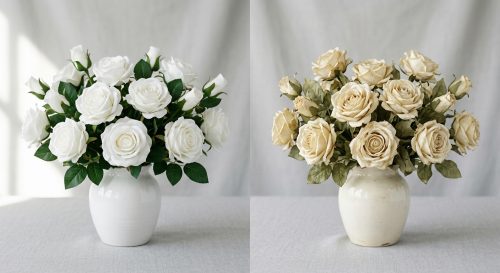
Whites and pastels show yellowing first. Saturated blues, greens and deep pinks absorb the shift for far longer, which is why the blue hydrangea in an open terrace and the cream one under a porch are not the same purchase. A covered porch, an open terrace and a glazed atrium are three different specifications even when the palette matches.
A European hotel supply distributor moved its entire orchid and rose line from silk to PU after guest feedback. The upgrade cost roughly 25% more per arrangement, and the hotel reorder rate rose by more than 40% the following year. Guests judge the material every time they sit down, and procurement sees the result in the reorder file.
Colour is mixed per batch. An order placed six months later can land a visible shade off, and the cause is rarely the supplier's competence. The specification lived in someone's inbox instead of on the purchase order.
The payoff is measurable. A hotel chain ordering lobby arrangements across 40 properties pinned stem count per SKU down to the filler ratio and could still reorder matching replacement bouquets two years later. That outcome came from the document, not from memory, and the same discipline is what planners sourcing a thousand stems without colour inconsistency rely on every season.
The company behind this site, Xuzhou Blossom Sparkling Art&Crafts Co.,Ltd, is based in China, and the mechanics are the same with any factory anywhere: a spec sheet turns a conversation into a document you can send again in eighteen months.
A flattened head is not a damaged head. Fabric and PU film both relax back with gentle heat and moisture, which is why force is the wrong first move and why a carton that looks alarming on arrival usually is not.
The company's factory uses acid-free tissue and BHT-free packaging for white and pastel SKUs, because ordinary tissue and antioxidant-treated wraps are common causes of yellowing and print transfer on light colours. Cartons for delicate white florals should be stacked no more than 4 high. That is guidance worth writing into your own warehouse receiving instructions as well as the supplier's packing spec, since the damage usually happens after the goods arrive.
Store in shaped trays or upright, away from heat sources and sunlight, and out of the humidity swings that stiffen PU film. The guide to bulk artificial flower packaging covers carton configuration and interleaving in more detail than a single paragraph can.
Twelve lines turn a hopeful enquiry into a comparable quotation. Send them to every supplier on your shortlist, including us.
Ask for a photographed sample against a ruler and a colour card, never a catalogue render. A render cannot show floret density or surface finish, which are two of the four numbers this entire decision rests on. Order one full carton rather than a handful of heads, because crush behaviour and colour consistency only show up across a packed carton. Then score the replies side by side, and treat any line left blank as a line the supplier cannot guarantee.
15 years in artificial plants, 5,000+ varieties of flowers, plants and trees, up to 30+ colour options, 300,000+ units of monthly capacity across a network of more than 150 allied factories, and OEM/ODM work on colour, size, packaging and branding for buyers in over 50 countries. Send your display brief with this spec sheet and ask for hydrangea head samples at two diameter grades. The size decision is much easier to make on a table than in a catalogue.
There is no universal number, because it depends on head diameter and container mouth. Measure the rim, choose a head that reads slightly wider than the rim is deep, then test one arrangement before ordering. Once that single arrangement is right, multiply heads per arrangement by the number of tables and add a spare allowance for handling.
Usually yes, if the head has a socket or wire stub rather than a moulded stem. Buy heads specified as loose or wired for fabrication, and match the new stem gauge to the head weight. Heads moulded onto their stem cannot be re-stemmed cleanly, so confirm the mount type before ordering loose heads in volume.
Most suppliers quote per stem, which is why comparisons go wrong. A single-head stem and a multi-head spray are different products at different prices. Convert every quote to cost per usable head after deducting crushed or unusable heads, then compare. Ask for price breaks at head-count tiers so the quote matches how you actually build displays.
 Knowledges
 Knowledges
 Knowledges
 Knowledges
 Knowledges
 Knowledges